
Even if you don't have much free time to dedicate to your language learning, a smart routine can make all the difference. We can't promise you'll learn a language in a month, but apply these principles and your results will stick. Start by building tiny habits you can keep, practice deliberately, and, most importantly, change your mindset about learning.
Growth Mindset
Many of us dismiss ourselves with "I've never been good at languages." Traditional learning focuses so much on results rather than the learning process that people end up drawing the wrong conclusions about their abilities.
Research in education and psychology consistently shows that your attitude toward learning affects your outcomes as much as your innate ability. This is where a growth mindset becomes your advantage. It's a belief that your intelligence is largely within your control. People with a growth mindset take on more challenging tasks without much pressure—failure doesn't define them, it points them toward a better strategy.
A fixed mindset can trap you in the belief that ability is inherited—and if you don't have natural talent, you won't succeed. Every failure then becomes proof of an inadequacy you can't fix. Later in life, even high achievers with a fixed mindset tend to choose tasks that prove their competence to others rather than ones that genuinely challenge them. They often plateau early as a result.
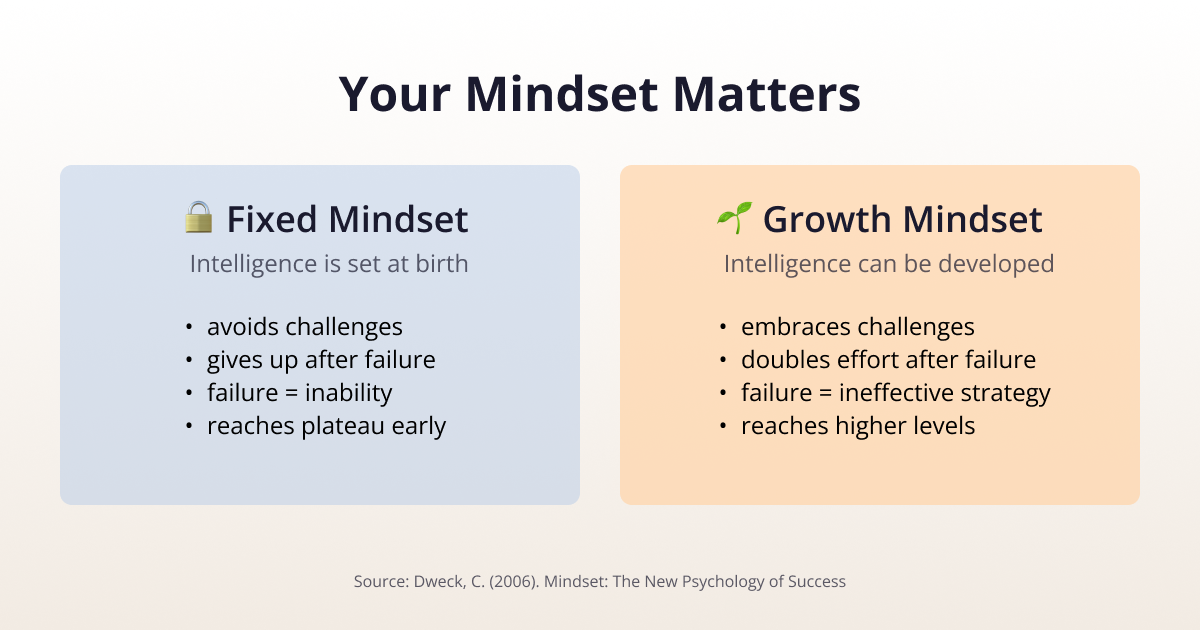
This is especially important for language learners. A growth mindset helps you accept a few uncomfortable truths about adult language learning:
- to get conversational, you need to sound foolish at first
- to get your pronunciation right, you need to get through the mumbling stage
- to become fluent, you need to make mistakes—and keep going anyway
Once you understand that talent rarely competes with dedication, curiosity, and deliberate effort, you can take charge of your learning. Language learning is a long game, and the learners who succeed are the ones who keep showing up even when progress feels slow. The good news: your brain is more adaptable than you think, and building the right routine is how you put that to work.
Start tiny
The best routine is the one you can keep. Start as small as you can. Your language learning habits will snowball with this approach.
Imagine you'd like to be more active in your daily life. The decision is made, and you're motivated and energized. You decide to walk everywhere from now on—groceries, work, friends. Most of us will be exhausted and burned out by the end of the week, let alone a month. It says nothing about your motivation. The commitment is simply beyond your current capacity. It doesn't have to be something as extreme as running a marathon to feel out of reach. It all depends on where you are right now.

Think of it like this: what's the smallest commitment you can think of—something that doesn't even feel like a commitment? The trick is simple: the smaller you start, the faster you get to the point where you're walking almost everywhere without thinking about it. But it starts with one tiny commitment, like taking the stairs instead of the elevator just once a day. The goal is to reduce friction and make sure you can actually sustain this long-term.
Your tiny commitments in language learning might be:
- listening to a 10-minute video in your target language a day
- looking up just one new word in your target language and adding it to your flashcards
- doing just one Glossika session a day
- reviewing your flashcards for 5 minutes
One day you'll notice this routine has become second nature—that's when you add the next tiny thing.
Habit-stacking
This one works wonders when paired with the tiny commitment approach. The smartest way to make a new habit stick is to tie it to an existing one. You may be familiar with this concept from James Clear's bestseller Atomic Habits. He popularized the term, but the idea has been around for a while.
Here's the formula James Clear suggests:
After/Before [CURRENT HABIT], I will [NEW HABIT].
Let's say you're prescribed a new medication and need to take one pill every morning, but you often forget. Your brain struggles to remember it because your morning already consists of a familiar routine that runs on autopilot—brushing your teeth, pouring a cup of coffee, preparing lunch for your kids, and so on. The easiest fix: tie the new habit to something you already do automatically. From now on, you drink your morning coffee and take the pill right afterward. Religiously, every day. By the end of the week, you'll likely be doing it without even thinking.
Some habits require more discipline than others—and language learning is one of the more demanding ones. It's difficult, and you'll experience more friction. To counteract this, consider adding one word to Clear's formula: During. Some language learning tasks are passive but still effective—and they're perfect for stacking.
Let's build on our examples from the previous part to make them even stronger with habit-stacking:
- listening to a 10-minute podcast in your target language a day while brushing your teeth or doing skincare before bed
- looking up just one new word whenever you come across it while scrolling
- doing just one Glossika session a day while doing the dishes
- reviewing your flashcards for 5 minutes on the way to work
You're going to do your existing habits and chores anyway. Stacking language learning on top is far more effective than carving out an extra 10 minutes every day for a dedicated study session.
You need deliberate practice too
Once you've built your foundation of language-learning habits, move to deliberate practice. You won't get very far without it.
Deliberate practice requires your undivided attention and a systematic approach. It also focuses on tasks just beyond your current level of competence and comfort. In other words, it takes considerable and sustained effort to do something you can't yet do well.
Listening to a podcast while brushing your teeth is at its core a passive practice. You won't always be fully engaged, and it might not always be challenging enough for you to grow. But writing a short story about your day without a dictionary, taking a quiz on words you learned last month, or trying to speak to a native speaker even if you feel intimidated—these challenge you in exactly the right way.

To make your deliberate practice successful, you'll need to:
- Set a specific goal: not "learn more vocabulary" but something task-based like "I want to order at a restaurant" or "give a work presentation without stumbling over my words."
- Get regular feedback: ideally find a teacher to guide you through the process. You'll avoid repeating the same mistakes and progress faster.
- Choose concentration over long hours: one hour of fully concentrated practice beats two hours of going through the motions.
- Increase difficulty over time: be honest with yourself about when you're plateauing and push into new territory.
Deliberate practice won't feel good: it's often tedious, frustrating, or emotionally challenging, but it's essential if you want to make real progress. Push through the discomfort. Difficult tasks and corrected mistakes are your most reliable path to improvement.
What your realistic routine might look like
Tying all of this together, here's what your language-learning routine might look like:
- Daily: small tasks tied to your existing habits—listening to content in your target language, adding one new word to your flashcard app.
- Weekly: push yourself to do deliberate practice sessions. Read a difficult article, try to speak with a native speaker, write a short journal entry. These sessions need to feel hard, but not unattainable.
- Monthly: do a check-in to make sure you're challenging yourself enough and actually making progress.
Here's what a realistic week might look like:
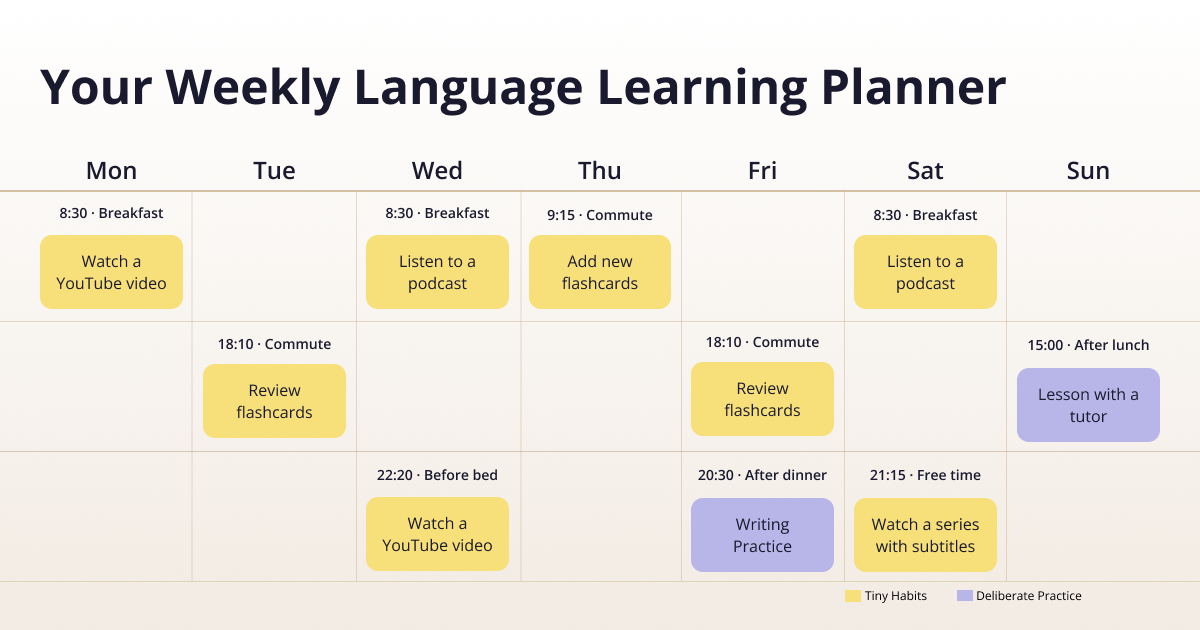
The tasks are tied to existing habits, they repeat naturally through the week, and roughly 80% are tiny habits while 20% are deliberate practice that requires real effort. If you're just starting out, even half of this is a great beginning.
Final Thoughts
Learning a foreign language can feel like an overwhelming goal. There's no fast or easy path to fluency, but there is a sustainable one. Combine tiny habits that fit naturally into your existing routine with deliberate practice sessions that genuinely challenge you, and you'll find yourself making steady progress. In the end, it all comes down to mindset. The simple thought "I can get better" goes a long way when mistakes and frustration are trying to convince you otherwise.
Want more study tips?
- 5 unconventional language learning strategies that actually work
- Should you use ChatGPT for language learning?
- "Language Laddering", or why you might use a foreign language to learn a foreign language
- Follow us on YouTube / Instagram / Facebook / Twitter

