An accurately translated sentence can still be misunderstood. In a hospital, a courtroom, or a contract negotiation, that misunderstanding carries real costs: an overlooked allergy, a waived right, a missed deadline. Professional interpreters help to convey meaning across cultures in the most sensitive situations.
What Causes Communication Gaps?
Communication gaps rarely come from a simple lack of vocabulary. More often, both people know all the words and still walk away with different messages.
For example, a physician asks an elderly Korean patient whether the pain has improved. The patient answers "yes" not because it has, but because in his community, contradicting a doctor face-to-face is disrespectful. The chart now says the treatment is working when in reality it doesn't.
Or imagine a defendant who hears the word "arraignment" and can define it. But does she understand the process behind it in her situation? She doesn't know whether she should speak, what happens if she stays silent, or what comes next. Knowing the word is not the same as knowing the road ahead.
The bottom line: just because someone is proficient in English doesn't mean they can navigate technical, medical, or legal language.
How Professional Interpreters Create Shared Understanding
Every message arrives wrapped in tone, cultural context, and often specialized terminology. A professional interpreter carries all of it across while keeping firm boundaries around their own role in the conversation.
They Communicate Meaning, Not Individual Words
Word-for-word translation often produces speech that is stiff at best and misleading at worst. Take the Spanish phrase "me duele hasta el alma" literally, "it hurts me to the soul." Translated word for word in a clinic, it sounds like the patient needs a therapist, not a doctor. An interpreter recognizes it as an idiom for severe pain and says exactly that.
They Preserve Tone and Intent
An urgent warning must sound urgent. A formal statement must retain its formality. A cautious answer should not sound certain. Professional interpreters carry tone, hesitation, and emotion intact. What the speaker says is what the listener hears: nothing softened, nothing added.

They Account for Cultural Differences
Language lives inside culture, and phrases that seem simple can conceal entirely different assumptions. In Japanese business settings, for instance, "zensho shimasu", roughly "I'll do my best" or "I'll handle it appropriately" is often a polite way of declining. An interpreter who hears it and understands the context can flag the ambiguity, sparing a foreign negotiator from leaving the room believing a deal is done.
They Manage Specialized Terminology
Much of the work happens before anyone speaks. An interpreter booked for a pharmaceutical licensing negotiation will spend the days beforehand studying the agenda, because "bioequivalence" and "orphan drug designation" are not terms anyone improvises accurately on the spot. A medical interpreter preparing for an oncology consultation reviews staging terminology — 'stage II' and 'grade 2' sound interchangeable to a layperson but mean very different things. This groundwork is what allows the interpreter to keep terminology precise and consistent.
They Maintain Confidentiality and Impartiality
Interpreted conversations often involve some of the most private aspects of people's lives, so the professional boundaries are essential.
For example, if a patient wants to disclose domestic abuse but the "interpreter" is her brother-in-law, she may never reveal the abuse at all. A professional interpreter, bound by confidentiality and with no personal stake in the situation, creates a safe environment where patients can speak honestly without fear of judgment or repercussions.
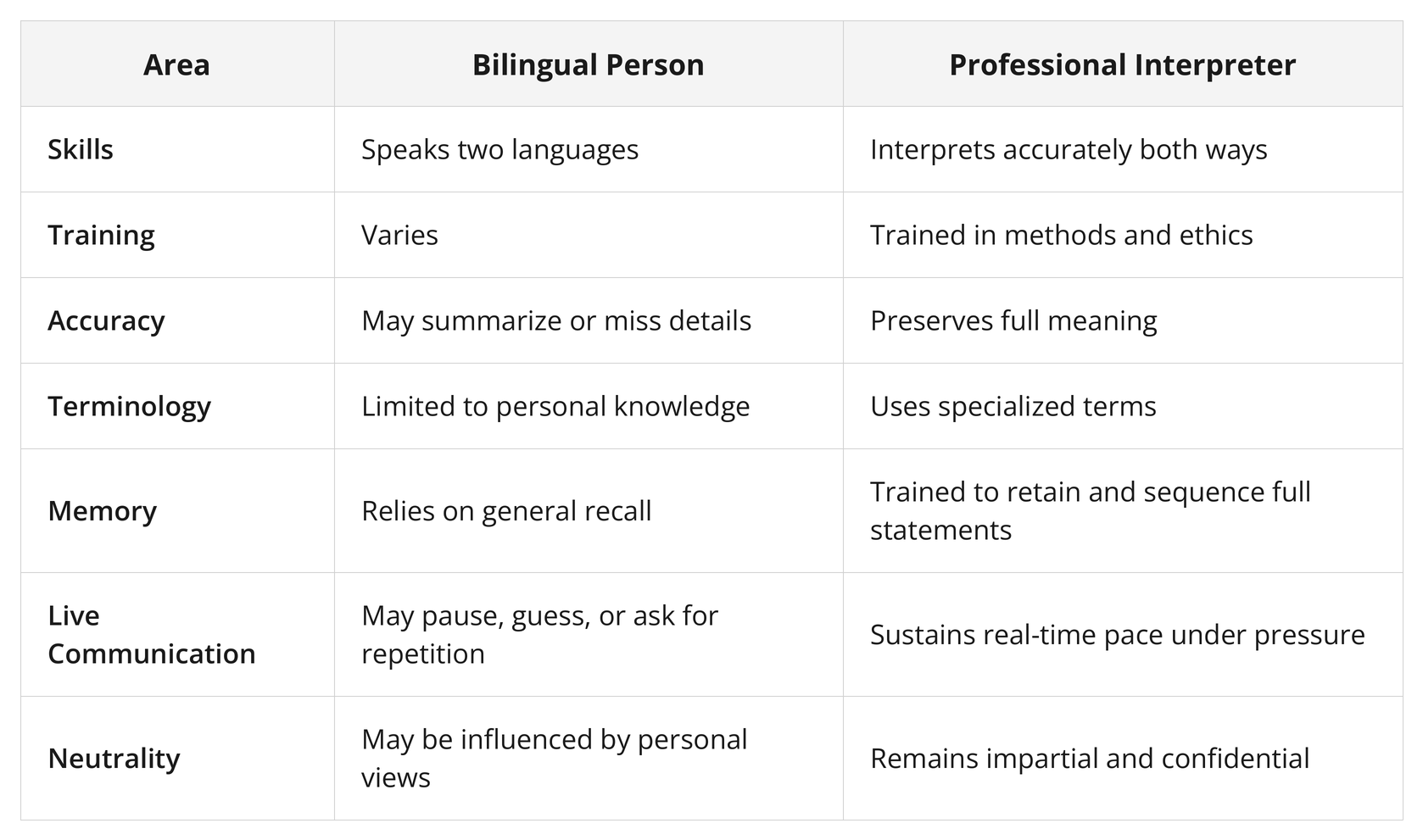
Why Being Bilingual Is Different From Professional Interpreting
Speaking two languages is a valuable skill, but it is only raw material. Professional interpreting is a discipline built on top of it, one that takes deliberate training.
"People often assume that if you speak two languages, you can interpret between them, but that's not how it works," says Philip Rosen, Founder and Managing Director of Capital Linguists, an interpretation and translation agency from the United States.
"Bilingualism gives you the raw material vocabulary and grammar in both languages. Professional interpreting is what you build on top of that: the ability to listen and speak at the same time, hold a complex thought in your head while rendering it accurately in another language, stay neutral no matter how charged the conversation gets, and know the specialized terminology for whatever field you're working in, whether that's law, medicine, or finance.”
Nowhere is the difference clearer than in simultaneous interpreting, where the interpreter must understand what is being said and deliver it in another language even as the speaker keeps talking. Under that kind of pressure, an untrained helper can make mistakes.
A clinician says, "Take two tablets twice daily," and the helper translates it as "take two tablets daily." One dropped word, and the patient is now taking half the prescribed dose. Untrained helpers also tend to filter: they may skip a detail that feels embarrassing to relay, or answer a question themselves instead of interpreting.
US healthcare rules limit reliance on untrained adults or children, except in narrow emergency situations.
Where Professional Interpreters Make the Greatest Difference
Professional interpreters matter most where a misunderstanding carries a real price. A garbled sentence can change a decision, endanger someone, or cost them a legal right.
International Business and Conferences
In a business setting everyone in the room needs to follow one discussion and be able to respond to it as it happens. Suppose an inernational supplier describes a delivery date as “the first Friday after the holiday.” An interpreter asks for the exact date when different holiday calendars create doubt. This small check protects the schedule from an avoidable error.
Healthcare
Patients need the freedom to explain what they are experiencing in their own words, rather than relying on a shortened or incomplete summary. A patient might nod after hearing discharge instructions out of politeness, not understanding. An interpreter relays the instructions and the patient’s questions, then lets the clinician check understanding directly.
Legal and Government Settings
Small omissions change how a statement is understood. Federal court ethics rules tell interpreters to preserve the level of language without additions, omissions, or explanations. They also require interpreters to stay within their role and avoid legal advice or personal opinions.

Education and Community Services
A parent planning their child's education with the school, or a family applying for housing, may not share the institution's language. Interpreters keep these discussions direct. For example, a school might explain an individualized education program through several abbreviations. The interpreter asks the speaker to define unexplained shorthand and preserves the parent’s questions without answering for the school.
Choosing the Right Type of Interpreting
Interpreting comes in several formats — consecutive or simultaneous, on-site or remote — and each is built for a different kind of conversation, so it helps to know how they differ before choosing one.
Consecutive Interpreting vs. Simultaneous Interpreting
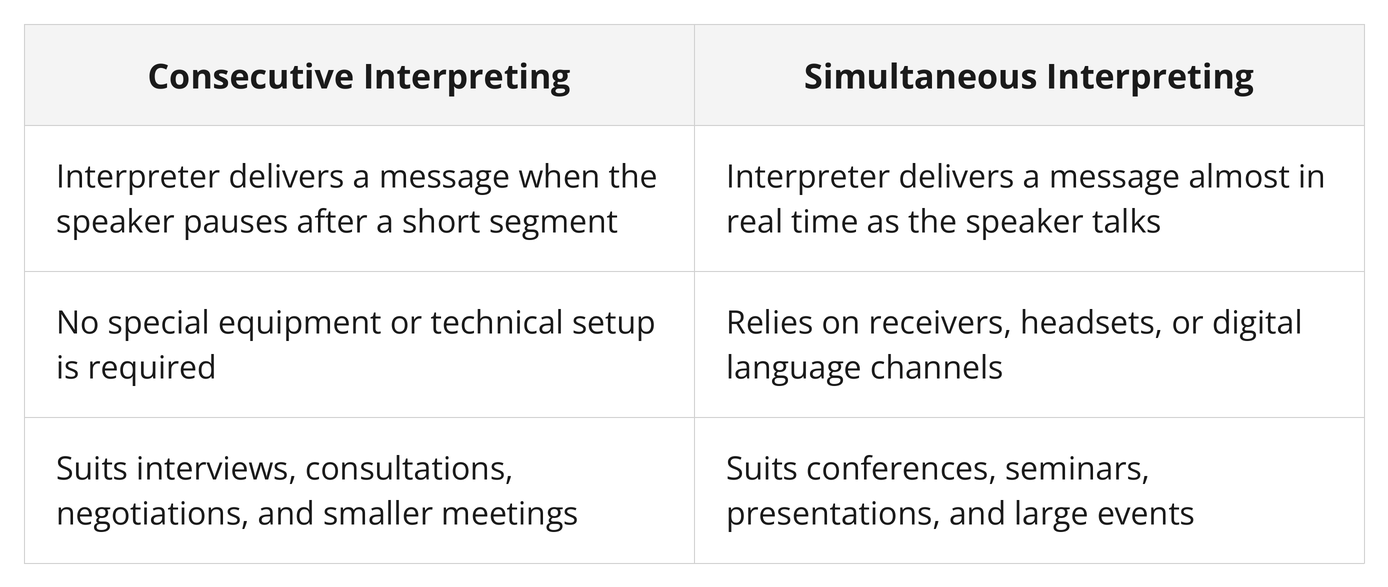
The two main modes of interpreting — consecutive and simultaneous — differ in how the message is delivered, what equipment they require, and the settings they suit best.
On-Site vs. Remote Interpreting
On-site interpreting suits medical visits, court proceedings, site tours, and meetings where facial expressions, body language, or room movement matter. Meanwhile, remote formats suit distributed teams, shorter appointments, urgent access, and locations without a suitable local interpreter. Video fits meetings where facial cues or signed language matter.
What works best for you?
Choosing between different formats of interpreting comes down to a few practical factors: the size and pace of the meeting (large, fast-moving events favor simultaneous, while smaller, slower ones suit consecutive), how specialized the subject matter is, whether the setting demands an in-person presence or handling of sensitive information, and what technology is available — stable connections and audio for remote work, or booths, headsets, and receivers for simultaneous setups.
How to Work Effectively With an Interpreter
Good preparation supports a clear and accurate exchange. Share key information early, speak in a direct way, and give the interpreter enough time to complete each message.
Before the event:
- Confirm the correct language and regional dialect.
- Share the purpose, agenda, names, and key terminology before the session.
- Test microphones, cameras, links, and headsets before remote or conference sessions.
During the event:
- Speak directly to the other participant and use the first person.
- Keep each statement short and pause after a complete idea.
- Avoid side conversations and explain unfamiliar abbreviations.
One honest caveat: professional interpreting reduces avoidable misunderstandings, but it does not guarantee a legal, medical, financial, or business result.
What early planning does guarantee is a better-prepared interpreter and a much easier time choosing the right provider. Choose a provider with qualified, industry-specific interpreters, strict confidentiality standards, and flexible delivery options.